ASUS ROG Strix G16 (2024) vs Samsung Galaxy Book4 360

The Verdict
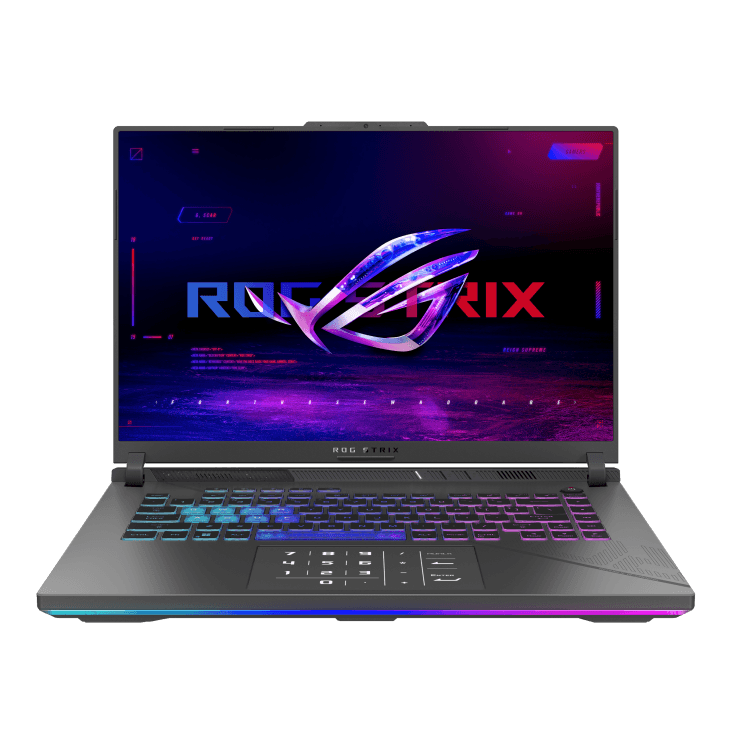
ASUS ROG Strix G16 dominates for gaming and content creation with its Intel Core i9-14900HX, 240Hz 2560x1600 display, and superior thermal design built for sustained performance. Samsung Galaxy Book4 360 excels as a productivity ultrabook, offering exceptional portability at 1.65kg, 14-hour battery life, and a versatile 2-in-1 touchscreen form factor ideal for professionals. Storage-wise, the ASUS provides double the capacity (1TB vs 512GB) with upgrade potential, while Samsung prioritizes thinness and weight. Display brightness favors ASUS at 500 nits versus 400. Battery longevity strongly favors Samsung's efficiency-focused design. The $250 price difference reflects their distinct purposes: choose ASUS for gaming/workstation performance, or Samsung for business mobility and everyday versatility.
Who Should Buy
Buy the ASUS ROG Strix G16 (2024) if…
- →RTX 4070 Laptop GPU handles 1440p gaming at high settings
- →240Hz 2.5K display is incredibly smooth for competitive gaming
- →90 Wh battery is large for a gaming laptop
Buy the Samsung Galaxy Book4 360 if…
- →Versatile 360-degree 2-in-1 design with touch AMOLED
- →Samsung S Pen stylus supported for note-taking
- →Excellent Samsung Galaxy ecosystem integration
Category Scores
Pros & Cons
ASUS ROG Strix G16 (2024)
Pros
- RTX 4070 Laptop GPU handles 1440p gaming at high settings
- 240Hz 2.5K display is incredibly smooth for competitive gaming
- 90 Wh battery is large for a gaming laptop
- Excellent thermal design with liquid metal compound
- 1 TB SSD with a second expandable slot
Cons
- Heavy and thick — not a portable daily driver
- No webcam — requires an external camera
- Fan noise under load is significant
- Battery life is short under gaming loads
Samsung Galaxy Book4 360
Pros
- Versatile 360-degree 2-in-1 design with touch AMOLED
- Samsung S Pen stylus supported for note-taking
- Excellent Samsung Galaxy ecosystem integration
- Good 14-hour battery life for a convertible
- Sleek aluminum build at reasonable weight
Cons
- FHD+ resolution looks soft on a 15.6-inch screen
- No SD card reader
- RAM and SSD soldered — no upgrade path
- Hinge adds weight vs. a comparable clamshell
- No discrete GPU option
Full Specifications
| Spec | ASUS ROG Strix G16 (2024) | Samsung Galaxy Book4 360 |
|---|---|---|
| Software | Windows 11 Home | Windows 11 Home |
| Body | ||
| Weight | 5.29 lbs (2.4 kg) | 1.65 kg |
| Material | Aluminum and plastic | Aluminum |
| Dimensions | 13.94 x 10.35 x 0.92 inches | 356.3 x 229.0 x 14.9 mm |
| Ports | ||
| HDMI | 1 | |
| USB-A ports | 2 | 2 |
| USB-C ports | 2 | 1 |
| SD card | ||
| Thunderbolt ports | — | 2 |
| Battery | ||
| Battery life | Up to 6 hours | Up to 14 hours mixed use |
| Capacity | 90 Wh | 68 Wh |
| Display | ||
| Size | 16 inches | 15.6 inches |
| Type | IPS | FHD+ Dynamic AMOLED 2X touch 2-in-1 |
| Resolution | 2560 x 1600 | 1920 x 1080 |
| Refresh rate | 240Hz | 120Hz |
| Brightness (nits) | 500 | 400 |
| Storage | ||
| SSD | 1 TB PCIe Gen 4 NVMe | 512 GB NVMe |
| Expandable storage | ||
| Keyboard | ||
| Backlit | ||
| Touch Bar | — | |
| Processor | ||
| RAM | 16 GB DDR5 | 16 GB LPDDR5x |
| Cores | 24 cores (8P + 16E) | 16-core (6P+8E+2LPE) |
| Chipset | Intel Core i9-14900HX | Intel Core Ultra 7 155H |
Related Comparisons
This comparison is based on verified manufacturer specifications covering display, performance, camera, battery, and build quality. Scores are generated by analyzing specs across weighted categories on a 10-point scale. Learn more about our methodology.
Explore more in laptops, see all ASUS products or all Samsung products. View full details for the ASUS ROG Strix G16 (2024) or the Samsung Galaxy Book4 360.