Apple iPhone 17 Pro Max vs Oppo Reno16 F

How They Compare
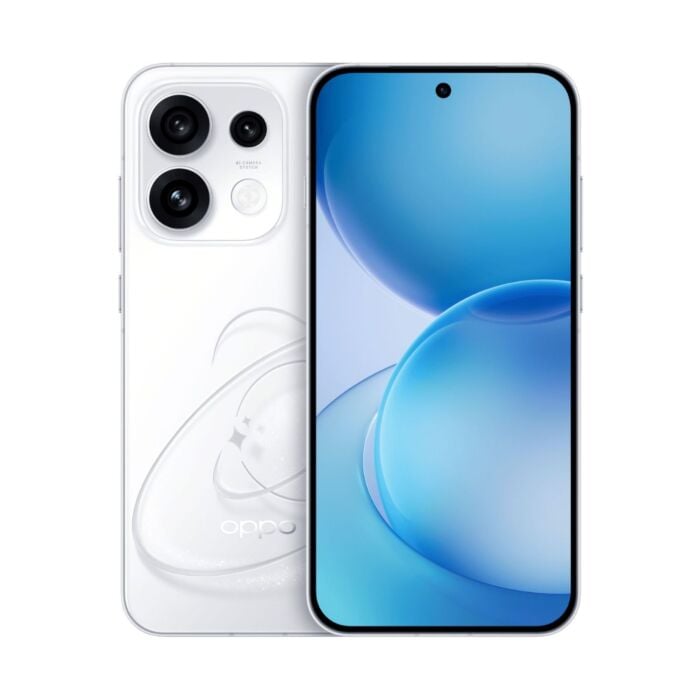
The Apple iPhone 17 Pro Max and Oppo Reno16 F sit in the same category and end up appealing to slightly different buyers. The Oppo Reno16 F is the cheaper of the two at $590 versus $1,199, a difference of about $609. The spec table below ranks 9 of their differences, and they do not all point the same way: the Apple iPhone 17 Pro Max wins on screen size (6.9 inches vs 6.57-inch) and ultra-wide camera (48 MP, f/2.2, 13mm vs 8MP ultrawide with autofocus), the Oppo Reno16 F on main camera (50MP primary with OIS vs 48 MP, f/1.8, 24mm, OIS) and selfie camera (50MP ultrawide with autofocus vs 18 MP, f/1.9, 20mm Center Stage). The Oppo Reno16 F is the newer of the two, released in 2026 against 2025. The pros lists below lead with — Apple iPhone 17 Pro Max: Three 48MP rear cameras, including a 100mm periscope at 4x optical that Apple extends to an 8x optical-quality crop; Oppo Reno16 F: 7,000 mAh battery with 80W fast charging provides long endurance and quick top-ups. Use the side-by-side spec table below to compare display, camera, processor and battery in detail and decide which one fits your priorities.
Who Should Buy
Buy the Apple iPhone 17 Pro Max if…
- →Three 48MP rear cameras, including a 100mm periscope at 4x optical that Apple extends to an 8x optical-quality crop
- →3,000 nits peak outdoor brightness on a 6.9-inch LTPO panel that scales down to 1Hz
- →5,088 mAh on the eSIM-only model, which is how Apple reaches its 39-hour video figure
Buy the Oppo Reno16 F if…
- →7,000 mAh battery with 80W fast charging provides long endurance and quick top-ups
- →Dual 50MP rear cameras both feature OIS, including a 3.5x optical zoom telephoto lens
- →50MP front camera with 4K video and 100-degree FOV is well above average for selfies
Pros & Cons
Apple iPhone 17 Pro Max
Pros
- Three 48MP rear cameras, including a 100mm periscope at 4x optical that Apple extends to an 8x optical-quality crop
- 3,000 nits peak outdoor brightness on a 6.9-inch LTPO panel that scales down to 1Hz
- 5,088 mAh on the eSIM-only model, which is how Apple reaches its 39-hour video figure
- Storage runs to 2TB, and ProRes RAW capture makes that useful rather than theoretical
- Ceramic Shield 2 on both front and back, with an IP68 rating good to 6 m
Cons
- Apple's 50%-in-20-minutes figure needs a 40W adapter, sold separately
- 233 g is heavy even by large-phone standards
- $1,199 starting price, and the 2TB tier costs considerably more
- The aluminium unibody is a step back from the titanium frame of the 16 Pro on feel, whatever it does for heat
- USB-C tops out at 10Gbps (3.2 Gen 2), so offloading 2TB of ProRes RAW over the cable is slow
Oppo Reno16 F
Pros
- 7,000 mAh battery with 80W fast charging provides long endurance and quick top-ups
- Dual 50MP rear cameras both feature OIS, including a 3.5x optical zoom telephoto lens
- 50MP front camera with 4K video and 100-degree FOV is well above average for selfies
- Comprehensive IP66/IP68/IP69/IP69K dust and water resistance covers multiple real-world scenarios
Cons
- MediaTek Dimensity 7300 is a mid-range chip that will struggle in sustained heavy workloads or gaming
- Charging speed is capped at 45W in European markets, reducing a key hardware advantage
- Connectivity details are unconfirmed, which raises uncertainty around 5G band support and Wi-Fi standards
Full Specifications
| Spec | Apple iPhone 17 Pro Max | Oppo Reno16 F |
|---|---|---|
| Software | iOS 26 (upgradable to iOS 27) | Android 16 with ColorOS 16 |
| Body | ||
| Overview | — | 3D Pop Planet Design, squircle camera island, IP66/IP68/IP69/IP69K rated, Splash Touch support, colors: Pop White, Twilight Violet, Dream Purple |
| Weight | 233 g | 196 g / 197 g |
| Material | Aerospace-grade 7000-series aluminum unibody, Ceramic Shield 2 front and back | — |
| IP rating | IP68 (6 m for 30 min) | IP66/IP68/IP69/IP69K |
| Dimensions | 163.4 x 78 x 8.8 mm | — |
| Camera | ||
| Overview | — | Rear: 50MP primary with OIS + 50MP 3.5x telephoto with OIS + 8MP ultrawide with autofocus; Front: 50MP ultrawide with autofocus, 100-degree FOV, 4K video, 4K Auto Straighten Video |
| Main camera | 48 MP, f/1.8, 24mm, OIS | 50MP primary with OIS |
| Front camera | 18 MP, f/1.9, 20mm Center Stage | 50MP ultrawide with autofocus |
| Video | 4K@24/25/30/60/100/120fps, ProRes and ProRes RAW, Spatial Video | — |
| Telephoto | 48 MP, f/2.8, 100mm periscope, 4x optical (8x optical-quality crop) | 50MP 3.5x telephoto with OIS |
| Ultrawide | 48 MP, f/2.2, 13mm | 8MP ultrawide with autofocus |
| Memory | ||
| Overview | — | Up to 12GB LPDDR4X RAM, up to 256GB UFS 3.1 internal storage |
| RAM | 12 GB | — |
| Storage options | 256 GB, 512 GB, 1 TB, 2 TB | 256GB |
| Battery | ||
| Overview | — | 7,000 mAh (6,500 mAh in Singapore, the UK, Australia and New Zealand), 80W wired charging (45W in Europe) |
| Capacity | 4823 mAh | 7,000 mAh (6,500 mAh in Singapore, the UK, Australia and New Zealand) |
| Charging | Up to 50% in 20 minutes with 40W adapter or higher | 80W |
| Wireless charging | 25W MagSafe / Qi2 | — |
| Display | ||
| Overview | — | 6.57-inch AMOLED, 120Hz refresh rate, FullHD+ resolution, 10-bit color depth, 1,400 nits peak brightness, 397 ppi, centered punch-hole cutout, optical in-display fingerprint reader |
| Size | 6.9 inches | 6.57-inch |
| Type | LTPO Super Retina XDR OLED, ProMotion | AMOLED |
| Resolution | 1320 x 2868 | — |
| Refresh rate | 1-120Hz adaptive | 120Hz |
| Brightness (nits) | 1000 typical / 1600 HDR / 3000 peak | 1,400 |
| Processor | ||
| Overview | — | MediaTek Dimensity 7300 SoC |
| CPU | Hexa-core (2x4.26 GHz & 4x2.60 GHz) | — |
| GPU | Apple GPU (6-core) | — |
| Chipset | Apple A19 Pro (3 nm) | MediaTek Dimensity 7300 |
| Connectivity | ||
| 5G | Not stated | |
| NFC | Not stated | |
| USB | USB-C 3.2 Gen 2 | — |
| Wi-Fi | Wi-Fi 7 | — |
| Bluetooth | 6.0 | — |
Want to compare a third product?
Add another product for a 3-way comparison.
Related Comparisons
Explore more in phones, see all Apple products or all OPPO products. View full details for the Apple iPhone 17 Pro Max or the Oppo Reno16 F.