Apple iPhone Air vs Motorola Edge 70 Fusion

How They Compare
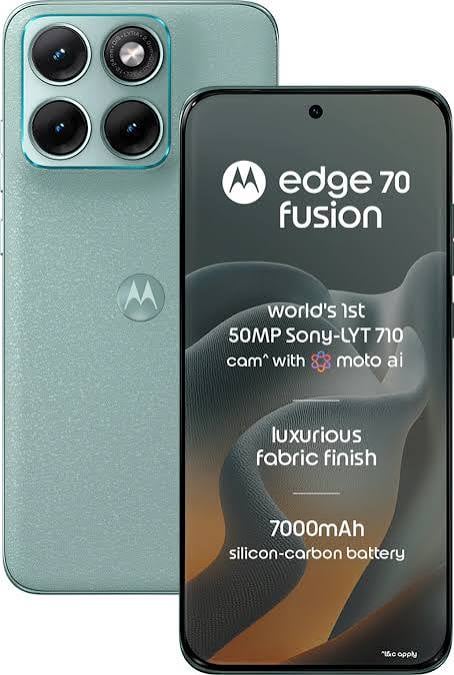
The Apple iPhone Air and Motorola Edge 70 Fusion sit in the same category and end up appealing to slightly different buyers. The Motorola Edge 70 Fusion is the cheaper of the two at $395 versus $999, a difference of about $604. The spec table below ranks 10 of their differences, and they do not all point the same way: the Apple iPhone Air wins on weight (165 g vs 177 g (5200 mAh) / 193 g (7000 mAh)) and Wi-Fi (Wi-Fi 7 (802.11be) vs Wi-Fi 6E), the Motorola Edge 70 Fusion on battery capacity (7,000 mAh vs 3149 mAh) and screen size (6.78-inch vs 6.5 inches). The Motorola Edge 70 Fusion is the newer of the two, released in 2026 against 2025. The pros lists below lead with — Apple iPhone Air: 5.64mm and 165g — the thinnest iPhone Apple has made, and the weight difference against a Pro Max is immediately obvious in hand; Motorola Edge 70 Fusion: 7,000 mAh battery is among the largest in its price class, well above the typical 5,000 mAh found in mid-range rivals. Use the side-by-side spec table below to compare display, camera, processor and battery in detail and decide which one fits your priorities.
Who Should Buy
Buy the Apple iPhone Air if…
- →5.64mm and 165g — the thinnest iPhone Apple has made, and the weight difference against a Pro Max is immediately obvious in hand
- →A19 Pro with a 16-core Neural Engine, the same silicon family as the Pro models rather than a cut-down chip
- →3,000 nits peak outdoor brightness on a 460 ppi panel that scales down to 1Hz
Buy the Motorola Edge 70 Fusion if…
- →7,000 mAh battery is among the largest in its price class, well above the typical 5,000 mAh found in mid-range rivals
- →144Hz AMOLED display with 5,200 nit peak brightness delivers sharp, vivid visuals even in direct sunlight
- →512GB of storage is generous for a mid-range phone, where 256GB is the usual ceiling
Pros & Cons
Apple iPhone Air
Pros
- 5.64mm and 165g — the thinnest iPhone Apple has made, and the weight difference against a Pro Max is immediately obvious in hand
- A19 Pro with a 16-core Neural Engine, the same silicon family as the Pro models rather than a cut-down chip
- 3,000 nits peak outdoor brightness on a 460 ppi panel that scales down to 1Hz
- Ceramic Shield 2 on front and back, on a titanium frame, with IP68 good to 6 m
- $999 for Pro-tier silicon, which is $200 under the 17 Pro Max
Cons
- One rear lens. The 52mm "2x telephoto" is a crop of the 48MP sensor, and there is no ultrawide at all
- USB-C transfers at 480 Mb/s — USB 2.0 speed — so moving 1TB of footage off the phone means going wireless
- A single mono speaker, where every other iPhone 17 has a stereo pair
- eSIM only worldwide, with no SIM tray in any market, which makes swapping carriers abroad a provisioning problem rather than a physical one
- 3,149 mAh is small in absolute terms, and the 27-hour figure depends on a panel that spends most of its time at low refresh
Motorola Edge 70 Fusion
Pros
- 7,000 mAh battery is among the largest in its price class, well above the typical 5,000 mAh found in mid-range rivals
- 144Hz AMOLED display with 5,200 nit peak brightness delivers sharp, vivid visuals even in direct sunlight
- 512GB of storage is generous for a mid-range phone, where 256GB is the usual ceiling
Cons
- 68W charging is respectable but falls behind rivals like the Poco X7 Pro that offer 90W or faster at a comparable price
- Snapdragon 7s Gen 4 is a mid-range chip and will struggle with sustained heavy gaming compared to flagship Snapdragon 8-series devices
Full Specifications
| Spec | Apple iPhone Air | Motorola Edge 70 Fusion |
|---|---|---|
| Software | iOS 26 (upgradable to iOS 27) | Android 16 |
| Body | ||
| Overview | — | Plastic frame, likely IP54 splash resistance |
| Colors | Space Black, Cloud White, Light Gold, Sky Blue | — |
| Weight | 165 g | 177 g (5200 mAh) / 193 g (7000 mAh) |
| Material | Titanium frame, Ceramic Shield 2 front and back | Plastic frame |
| IP rating | IP68 (6 m for 30 min) | — |
| Dimensions | 156.2 x 74.7 x 5.64 mm | — |
| Camera | ||
| Main camera | 48 MP, f/1.6, 26mm, sensor-shift OIS | 50MP main with OIS |
| Front camera | 18 MP, f/1.9, Center Stage, autofocus | 32MP front camera |
| Video | 4K Dolby Vision @ 24/25/30/60fps, 1080p slo-mo @ 120/240fps | — |
| Telephoto | 12 MP, f/1.6, 52mm — a 2x crop of the 48MP main sensor, not a separate lens | — |
| Ultrawide | — | 13MP ultrawide |
| Memory | ||
| RAM | 12 GB LPDDR5X | 12GB |
| Storage options | 256 GB, 512 GB, 1 TB | 512GB |
| Battery | ||
| Capacity | 3149 mAh | 7,000 mAh |
| Charging | Up to 50% in 30 minutes with 20W adapter or higher | 68W wired |
| Wireless charging | 20W MagSafe / Qi2 | — |
| Display | ||
| Overview | — | 6.78-inch AMOLED, 144Hz refresh rate, 5,200 nit peak brightness |
| Size | 6.5 inches | 6.78-inch |
| Type | LTPO Super Retina XDR OLED, ProMotion | AMOLED |
| Resolution | 1260 x 2736 (460 ppi) | — |
| Refresh rate | 1-120Hz adaptive | 144Hz |
| Brightness (nits) | 1000 typical / 1600 HDR / 3000 peak | 5,200 nits |
| Processor | ||
| CPU | 6-core (2 performance + 4 efficiency) | — |
| GPU | Apple GPU (5-core) with Neural Accelerators | — |
| Chipset | Apple A19 Pro, Apple C1X modem | Qualcomm Snapdragon 7s Gen 4 |
| Connectivity | ||
| 5G | ||
| NFC | ||
| SIM | Dual eSIM only — no physical SIM tray in any market | — |
| USB | USB-C 2.0 | USB-C |
| Wi-Fi | Wi-Fi 7 (802.11be) | Wi-Fi 6E |
| Bluetooth | 6.0 | 5.4 |
Want to compare a third product?
Add another product for a 3-way comparison.
Related Comparisons
Explore more in phones, see all Apple products or all Motorola products. View full details for the Apple iPhone Air or the Motorola Edge 70 Fusion.